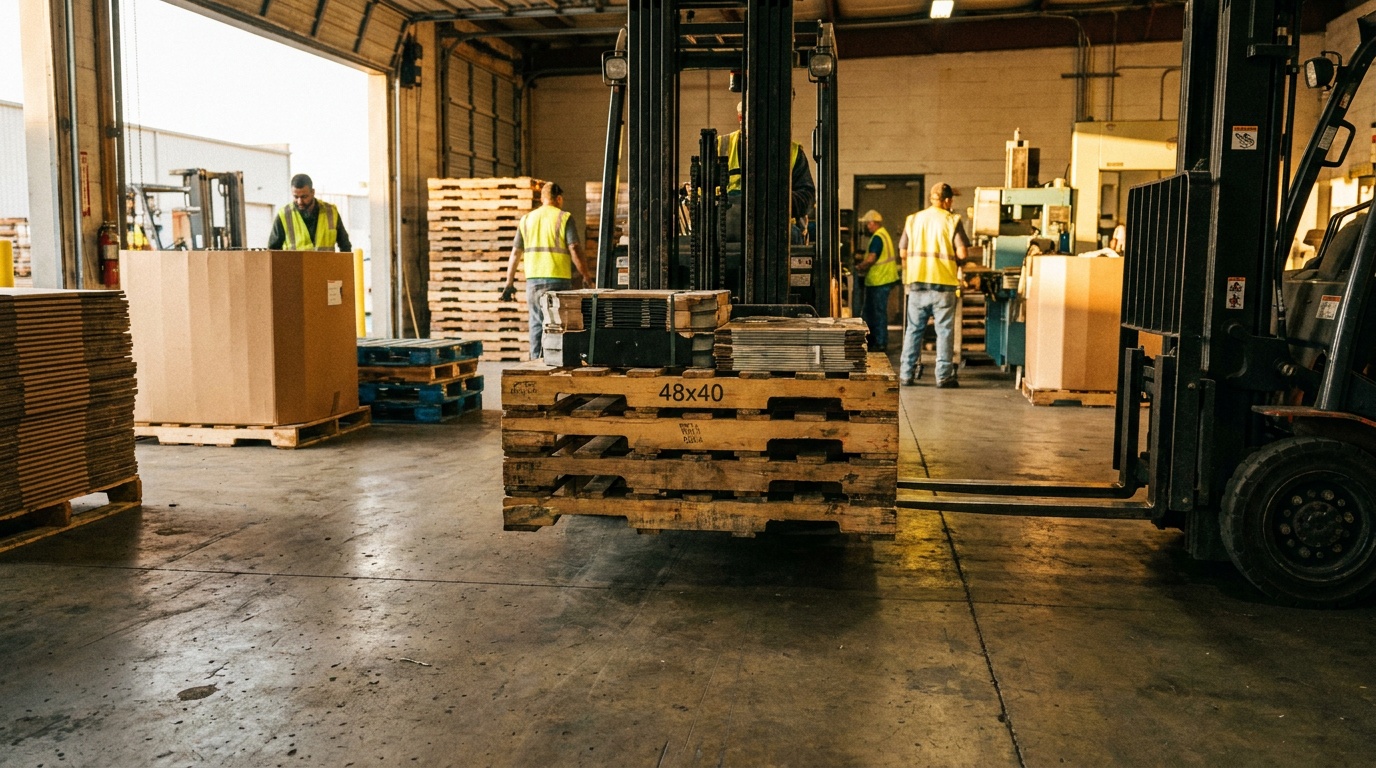
A 48x40 pallet is the industrial standard you'll see everywhere—grocery stores, manufacturing plants, distribution centers across Washington. It's 48 inches long, 40 inches wide, and it exists because decades ago the industry agreed on one size that works with every forklift, conveyor, and racking system in North America.
That standardization is why it matters. When you're not fighting custom sizes, equipment mismatches, or compatibility headaches, you save time and money. But there's more to know than just the numbers—and that's what we've learned from moving pallets in and out of warehouses in Kent, Renton, Auburn, Seattle, and Tacoma for years.
Why the 48x40 Size Became the Standard
In the 1960s, the Grocery Manufacturers Association decided the industry needed one pallet size. They landed on 48x40 inches because it fit the geometry of a standard shipping container, maximized warehouse floor space, and worked with every forklift design on the market. It was never sexy. It was pure math.
That decision stuck. Today, roughly 80% of all pallets sold in the United States are 48x40. If you need a pallet and don't specify otherwise, you're getting 48x40.
The reason it stayed the standard—and why it matters to you—is compatibility. You can load a 48x40 pallet at your facility in downtown Kent, send it across the country, and it will fit into every warehouse, truck, and dock system it encounters. No surprises. No delays. No equipment damage from forcing the wrong pallet size into a forklift designed for standard dimensions.
48x40 Pallet Weight & Load Capacity
An empty wooden 48x40 pallet weighs between 40 and 60 pounds depending on the construction type. Stringers (wooden beams running lengthwise) are lighter—around 40 to 50 pounds. Block pallets (constructed with solid wooden or plastic cylinders) are heavier, usually 50 to 60 pounds, because they're built stronger.
Load capacity is where people get confused. A 48x40 pallet can hold more weight than it should in normal operation.
Static load capacity (the weight it can hold sitting still in a warehouse) is around 1,500 to 2,000 pounds for a quality block pallet—more for industrial-grade models. But dynamic load capacity (the weight it can handle while being lifted and moved) drops to 1,200 to 1,500 pounds. And that's assuming:
- Your forklift is in good working condition
- The pallet is in good condition (no cracked boards, no bent stringers)
- The load is distributed evenly
- You're not stacking it on top of six other pallets in a high-rise warehouse
In our experience, customers in the Auburn and Tacoma areas who push a 48x40 pallet beyond 1,500 pounds usually experience damage within weeks—split stringers, crushed blocks, or a collapsed pallet in the middle of a delivery. It's cheaper to use two pallets than to clean up the mess.
Stringer vs. Block: Which One Do You Actually Need?
This is where most of our customers ask the practical question: "Do I need the expensive one?"
Stringer pallets use two or three wooden beams running lengthwise underneath the deck boards. They're lighter, cheaper (usually 30 to 40% less), and they work fine for most applications. The tradeoff: they don't last as long, especially if you're stacking them high or exposing them to moisture. We see stringer pallets start to weaken after 3 to 5 years of regular use.
Block pallets use solid wooden or plastic cylinders under the deck instead of beams. They distribute weight more evenly, they stack better, they last longer (7 to 10 years in normal conditions), and they handle rough treatment. They also cost more.
Here's the real answer: if you're a small operation in Renton using pallets for temporary storage, stringers are fine. If you're moving pallets in and out daily, stacking them 6 high, or shipping them internationally (some countries won't accept stringers), blocks are worth the cost.
We had a customer in Seattle who bought stringer pallets to save money, then had to replace them after two years because they were cracking under regular warehouse conditions. He spent more in the long run. That's the difference between a cheap decision now and a smart decision then.
48x40 Pallet Dimensions in Real Warehouse Space
Forty-eight by 40 inches sounds small until you're managing dozens of them.
A 48x40 pallet footprint is exactly 6,720 square inches—about 47 square feet. Standard warehouse pallet racking is designed around these dimensions. A single-deep rack can hold two 48x40 pallets side by side (96 inches wide). A standard shipping container fits nine of them: a 3x3 arrangement on the floor, stacked 4 high.
Most warehouses in Kent and surrounding areas stack 48x40 pallets 5 or 6 high in standard racking without modifications. Go beyond 6, and you're risking collapse, especially if the pallets are wooden stringers taking on moisture or if your load is shifting.
Height matters too. A 48x40 pallet with a standard deck is about 5.5 inches tall. If you're loading fragile items, add another 2 to 3 inches for packaging. Stack that 6 high, and you're at roughly 35 to 40 feet—manageable in most warehouses, but you need to account for clearance before you start loading.
When NOT to Use a 48x40 Pallet
We're always honest about this: a 48x40 is standard, but it's not always the best choice.
If you're shipping to Europe, they use 1,200mm x 1,000mm pallets—completely different system. If your product is smaller than 24x20 inches, you're wasting pallet space. If you need to ship something unusually heavy or oddly shaped, a custom pallet or a different configuration might make more sense.
And here's something nobody tells you: if you're getting a 48x40 pallet with heavy products like machinery or dense materials, the weight distribution can be awkward. We've seen forklift operators in Auburn struggle with a 1,400-pound load on a 48x40 because the weight shifted during handling. It's still within spec, but it's not comfortable to move, and discomfort leads to accidents.
For those situations, we'll recommend a different pallet, a reinforced variant, or splitting the load across two pallets.
Our Recommendation
Buy standard 48x40 block pallets for regular warehouse use. They're the right balance of cost and durability. Stringers work for light, temporary storage. For heavy or long-term use, blocks outlast stringers by years and cost less per year when you do the math.
And if you're in the Seattle, Tacoma, or Kent area and you're not sure what you need, call us. We can walk you through what actually makes sense for your operation instead of just selling you what's cheapest right now.
Looking for more? Read our guide on Best Pallet Supplier Washington State | A-1 Pallets.
Looking for more? Read our guide on A1 Pallets Inc: Your Trusted Pallet Partner in Washington.
Keep Reading
- Wood Pallet Weight and Dimensions — complete spec guide for stringer and block pallets
FAQ
What does a 48x40 pallet weigh? An empty stringer pallet weighs 40–50 pounds. A block pallet is slightly heavier at 50–60 pounds. Once loaded to standard capacity (around 1,500 pounds on a block, 1,200 on a stringer), total weight is usually 1,550–1,560 pounds. Always check your equipment limits.
Can I stack 48x40 pallets more than 6 high? Not safely in most warehouse setups. Standard practice is 5–6 pallets high depending on product weight, pallet condition, and your racking system. Stacking higher risks collapse and warehouse safety violations. We've seen damage from over-stacking in Auburn warehouses — it's not worth the risk.
Are all 48x40 pallets compatible with standard forklifts? Yes. Any standard forklift will fit the 48-inch length and 40-inch depth without adjustment. This is why it became the industry standard. Pallet jacks, pallet dollies, and conveyor systems all accommodate 48x40 without modification.
What's the difference between 48x40 stringers and blocks? Stringers use wooden beams underneath; blocks use solid wood or plastic cylinders. Blocks cost more but last longer and stack better. Stringers are cheaper and lighter. For most customers in Renton and Seattle, stringers work fine unless you're stacking high or shipping internationally.